
📈 Strategic imitation
Leveraging the "copycat approach" in business success
Michael Porter, one of the most influential thinkers in competitive strategy, famously argued that businesses achieve sustainable success by either pursuing cost leadership, differentiation, or focus strategies. Central to his philosophy is the idea that companies must make deliberate choices to create and sustain competitive advantage.
However, what if a company’s strategy doesn’t rely on pioneering innovation, but rather on observing successful competitors and adapting their models? While Porter emphasized differentiation and distinct positioning, the strategic value of imitation—when executed thoughtfully—cannot be overlooked.
”Strategic imitation”, has allowed many businesses to succeed by learning from the innovations and mistakes of others.
In this article we will explore the power of imitation, how it aligns with modern business principles, and why it remains a viable and professional approach in the competitive landscape.
The value of imitation
Imitation in business is not about copying blindly but about learning, adapting, and improving. When a company identifies a successful competitor (or business model), imitation allows it to leverage proven strategies while customizing them for new markets, audiences, or contexts. Michael Porter himself acknowledged that strategy involves understanding and reacting to competitors—imitation can be a part of this reaction.
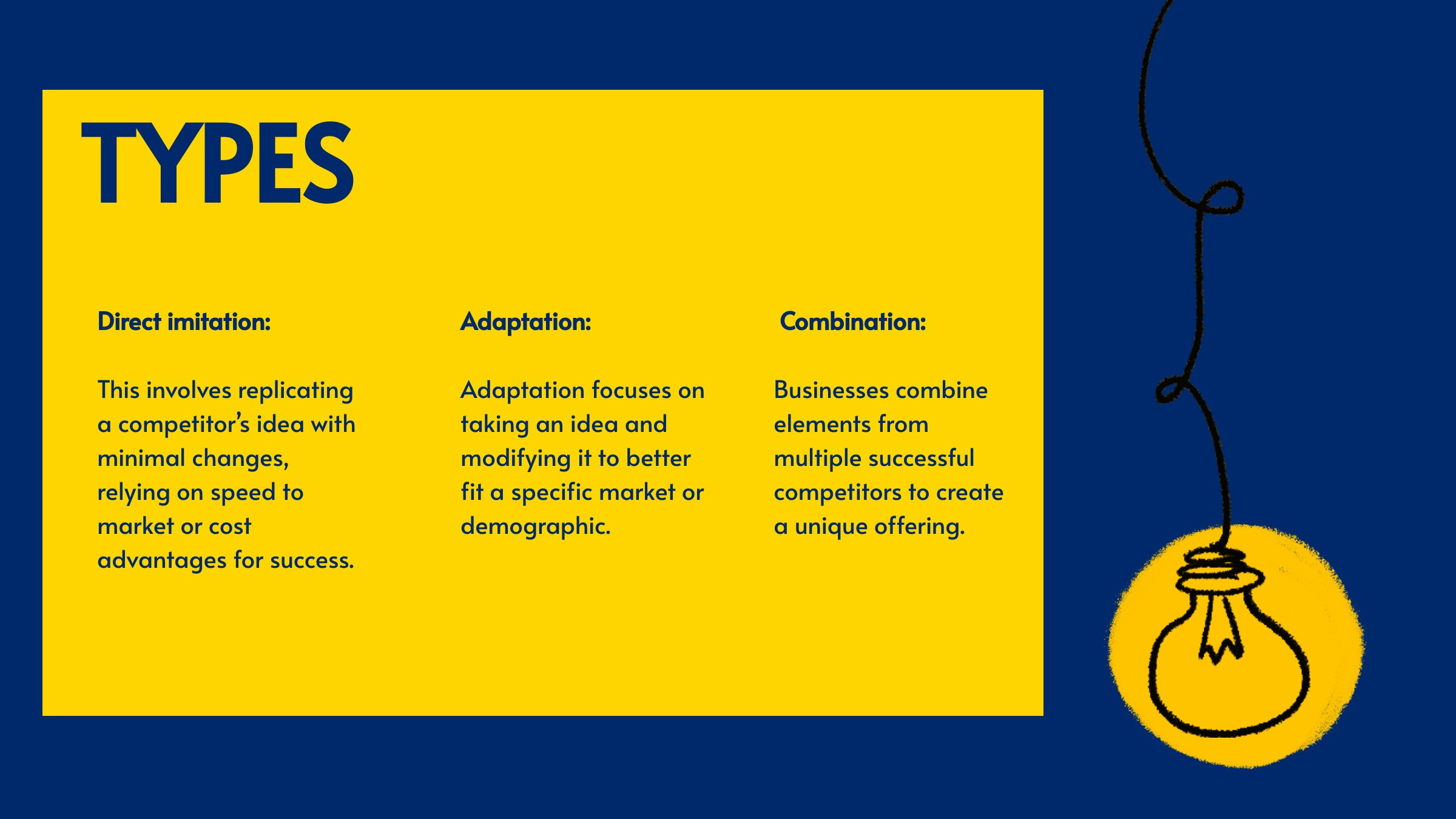
Imitation manifests in several forms, each with its own advantages and challenges:
1. Direct imitation
This involves replicating a competitor’s idea with minimal changes, relying on speed to market or cost advantages for success.
Example: Xiaomi closely mirrored Apple’s smartphone designs but positioned its products at lower price points, appealing to budget-conscious consumers in emerging markets.
2. Adaptation
Adaptation focuses on taking an idea and modifying it to better fit a specific market or demographic.
3. Combination
Businesses combine elements from multiple successful competitors to create a unique offering.
💡 Benefits of Imitation
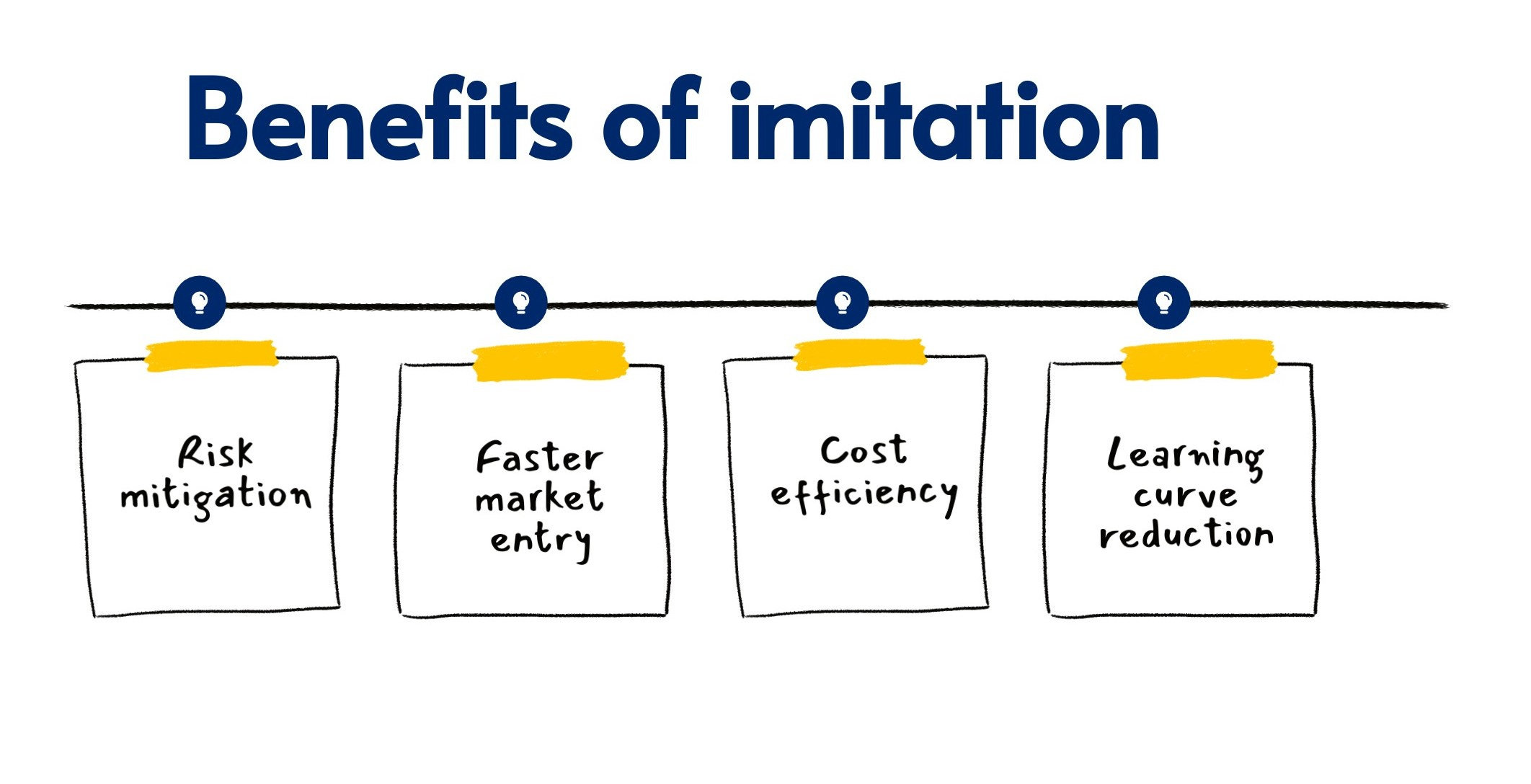
1. Risk mitigation
By imitating proven strategies, businesses reduce the uncertainties associated with launching untested products or services.
2. Faster market entry
Imitation allows companies to bypass lengthy R&D phases, entering the market quickly to capture demand.
3. Cost efficiency
Imitation minimizes the costs associated with invention while allowing companies to invest in scaling or marketing.
4. Learning curve reduction
Businesses can study competitors’ successes and failures to refine their approach.
🏢 Challenging misconceptions about imitation in business
Imitation is often misunderstood and undervalued as a strategic approach. By challenging common misconceptions, we can uncover its true potential as a powerful tool for growth, competition, and market adaptation. Here are 2 main misconceptions about imitation that deserve a closer look:
1. Imitation is weak
Many assume that imitation signals a lack of originality or strength, but the reality is far from that. Established firms often leverage their resources and scale to build upon innovations introduced by smaller players, using imitation to reinforce their market dominance. This strategy allows them to amplify existing ideas and capitalize on proven successes.
2. Imitation is easy
Another common misconception is that imitation is simply a matter of copying what others have done. In reality, imitation is far more complex and requires careful strategic planning. The success of an imitative strategy depends on understanding what to copy, how to improve it, and how to execute it better than the original.

🙏 Thanks for reading Market Intelligence Strategies!
Join over 2.000 professionals who are transforming their businesses with actionable insights and innovative ideas.
If you found this edition valuable, show your support by hitting the ❤️ and sharing it with your colleagues, friends, or on social media.
📩 Don’t miss out—subscribe today to stay ahead with the latest strategies!